Pothos Varieties: 15 Types from Common to Rare
Quick Summary
- Pothos (Epipremnum aureum) has dozens of cultivars — at least 15 are widely recognized
- All pothos share the same basic care: bright indirect light, let dry between waterings
- More variegation generally means higher light needs
- Satin Pothos (Scindapsus pictus) is NOT a true pothos but is commonly sold as one
- Rare varieties like Manjula and Jessenia can be found at specialty nurseries and plant swaps
Ask any plant enthusiast to name the easiest houseplant and pothos (Epipremnum aureum) is almost always in the top three. But pothos varieties go far beyond the familiar golden-splashed leaves most people picture. There are deep green jades, electric neons, silvery blues, and marbled cultivars so striking they barely look related. This guide covers 15 of the most popular and collectible types — what makes each one unique, how to tell them apart, and what care adjustments each variety prefers.
Why Are There So Many Pothos Varieties?
Pothos is native to the Solomon Islands and has been cultivated as a houseplant for over a century. Decades of selective propagation and natural genetic mutation have produced a wide range of leaf colors and patterns. All true pothos belong to the species Epipremnum aureum and share the same trailing, vining growth habit. The differences lie almost entirely in variegation — the presence, distribution, and intensity of non-green pigmentation in the leaves.
More variegated cultivars (those with heavy white, yellow, or silver markings) have less chlorophyll available for photosynthesis. This is why the golden rule of pothos care applies: the lighter the leaf, the more light the plant needs to thrive. Solid green varieties are the most forgiving in low light.
Pro Tip
A pothos will revert toward green in low light — the plant reduces variegation to maximize photosynthesis. If your Marble Queen is producing mostly green leaves, move it closer to a bright window. The variegation will return within a few growth cycles.
15 Pothos Varieties: Identification and Care Notes
1. Golden Pothos (Epipremnum aureum 'Golden')
The original and most common variety. Golden Pothos has heart-shaped, waxy leaves in medium green splashed with irregular golden-yellow variegation. The pattern is random — no two leaves are identical. It is the most forgiving pothos in low light conditions and grows faster than almost any other variety. If you can keep only one pothos, this is the one. Grows in practically any indoor condition and roots in water within days.
2. Marble Queen Pothos
A heavily variegated cultivar with white and cream marbling streaked through bright green leaves. The white portions can cover 40–60% of the leaf surface, making it one of the most visually striking varieties. Because of reduced chlorophyll, Marble Queen grows more slowly than Golden and needs brighter indirect light to maintain its variegation. Avoid direct sun, which scorches the white sections. One of the most popular pothos for home décor.
3. Neon Pothos
Completely solid chartreuse-yellow leaves with no variegation whatsoever. The neon lime color is uniform across the entire leaf — it is the result of pigment, not chlorophyll absence. Neon Pothos actually does well in moderate to bright indirect light, though the color fades toward green in low light. It stands out dramatically in a hanging basket or on a high shelf where the bright vines trail down. Great for adding a bold color pop to a room with neutral tones.
4. Jade Pothos
The most solid-green variety — deep, forest-green leaves with minimal to no variegation. Jade is the most tolerant of low light conditions of all pothos cultivars since it has full chlorophyll in every leaf. It is virtually indestructible and the ideal choice for dim offices, hallways, or bathrooms with frosted windows. Growth rate is steady and the trailing vines develop a lush, tropical look over time.
5. N'Joy Pothos
N'Joy has distinct, well-defined patches of white and green rather than the blended marbling of Marble Queen. The white sections are bright and clean, and the leaves tend to be smaller than Golden or Marble Queen. It grows more compactly, making it ideal for smaller spaces and shelves. N'Joy needs moderate to bright indirect light to prevent the white sections from reverting. A relatively newer cultivar that has become widely available in garden centers.
6. Pearls and Jade Pothos
Developed by the University of Florida, Pearls and Jade is a sport of N'Joy with an extra layer of complexity — the white sections feature fine green speckling and mottling rather than being solid white. This gives the variegation a softer, more intricate appearance. Leaves are smaller than most other varieties. It grows slowly but is well worth the wait for collectors who appreciate subtle detail.
7. Manjula Pothos
Patented by the University of Florida, Manjula features broad, heart-shaped leaves with a unique combination of white, cream, silver, and green in swirling, marbled patterns. No two leaves are the same. The edges often have a slight wave. Manjula is considered one of the rarer and more collectible pothos varieties — it does not propagate as easily as standard varieties, which keeps supply limited. Needs bright indirect light to maintain its complex variegation.
8. Cebu Blue Pothos
One of the most distinctive varieties — Cebu Blue has elongated, lance-shaped leaves (not heart-shaped) in a silvery, blue-green metallic color. As the plant matures and climbs on a support, the leaves can develop fenestrations (splits), making it look almost like a small Monstera. Young plants trail with small silvery leaves; mature climbing specimens produce much larger, perforated foliage. Native to Cebu Island in the Philippines.
9. Silver/Satin Pothos (Scindapsus pictus) — Technically Not a Pothos
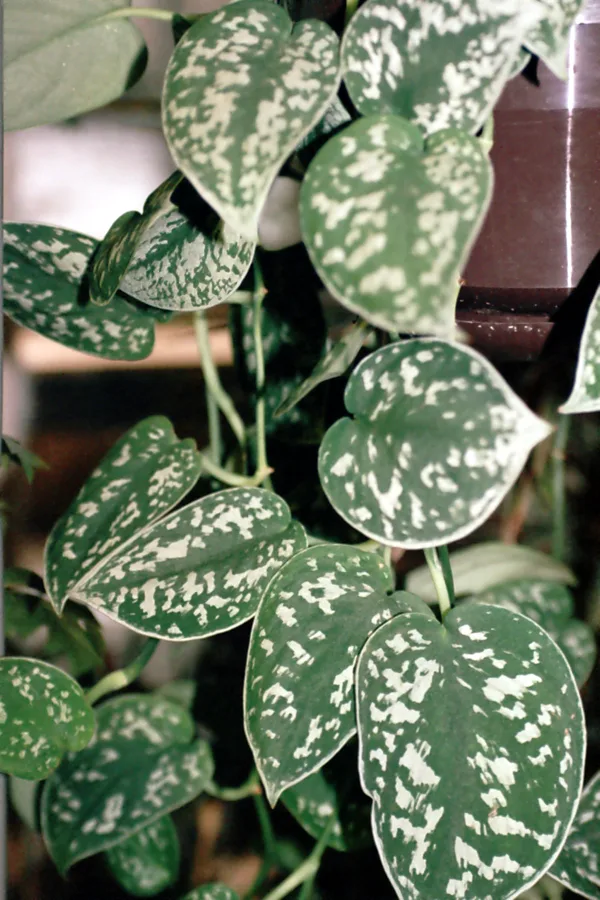
Sold in virtually every garden center under the name "Satin Pothos," this plant is actually a Scindapsus pictus — a related but distinct genus. The matte, velvety green leaves are dotted with silvery patches that almost shimmer. It is equally easy to grow as true pothos varieties, preferring similar care. The main difference: Scindapsus is more sensitive to overwatering and prefers to dry out more between waterings. Worth including in any pothos variety discussion because it is so commonly grouped with them.
10. Global Green Pothos
A newer arrival in the pothos world, Global Green features green-on-green variegation — lighter yellow-green centers against darker emerald edges. The pattern is the reverse of most pothos, where the variegation is typically on the outside. It is eye-catching in its subtlety and one of the most unique-looking varieties available at mainstream garden centers. Good tolerance for moderate light, grows vigorously.
11. Glacier Pothos
Glacier has small, silver-green leaves with streaks and edges of white and cream. The overall effect is cool and icy — quite different from the warm yellows of Golden Pothos. It is a slower grower with a more compact habit, making it suitable for smaller pots and tighter spaces. Often confused with N'Joy, but Glacier has more silver tones and smaller, narrower leaves with less pronounced white patches.
12. Emerald Pothos (Epipremnum aureum 'Emerald')
Emerald has deep, jewel-toned green leaves with a glossy finish and subtle lighter-green variegation. Some leaves show a faint emerald-to-lime gradient from the center out to the edges. It is bolder and darker than Golden Pothos without being as uniform as Jade. Grows vigorously under moderate to bright indirect light and produces impressively large leaves when allowed to climb.
13. Baltic Blue Pothos
Another newer cultivar gaining serious collector attention. Baltic Blue has bluish-green, dark leaves that develop deep fenestrations (holes along the midrib) even at a relatively young age. The fenestrations make it look more like a Monstera or Rhaphidophora than a typical pothos. It is one of the fastest fenestrating pothos cultivars and puts on a dramatic display when grown on a moss pole or trellis. Medium to bright indirect light recommended.
14. Jessenia Pothos
Jessenia is visually similar to Marble Queen but with lime-green and medium-green marbling rather than white-and-green. The variegation pattern is softer and more painterly — green tones blend into each other rather than the sharp white-green contrast of Marble Queen. It is a sport mutation of Golden Pothos and grows at a similar pace. One of the rarer varieties to find in stores; specialty plant shops and online sellers are the best sources.
15. Hawaiian Pothos
Hawaiian Pothos is essentially a mature form of Golden Pothos allowed to climb — when given a moss pole or bark support, Golden Pothos leaves can grow to 12 inches or more across, resembling the large jungle leaves of Monstera. Some nurseries sell mature specimens on poles as "Hawaiian Pothos." The care is identical to standard Golden Pothos; the dramatic difference is purely the result of vertical support triggering the plant's mature leaf form.
Pothos Varieties: Care Comparison Table
| Variety | Light Needs | Growth Rate | Difficulty | Availability |
|---|---|---|---|---|
| Golden Pothos | Low to bright indirect | Fast | Very Easy | Everywhere |
| Marble Queen | Bright indirect | Moderate | Easy | Everywhere |
| Neon Pothos | Moderate to bright | Fast | Very Easy | Common |
| Jade Pothos | Low to moderate | Moderate | Very Easy | Common |
| N'Joy | Moderate to bright | Slow–Moderate | Easy | Common |
| Pearls and Jade | Moderate to bright | Slow | Easy | Moderate |
| Manjula | Bright indirect | Slow | Moderate | Specialty |
| Cebu Blue | Moderate to bright | Moderate | Easy | Moderate |
| Silver/Satin (Scindapsus) | Moderate to bright | Moderate | Easy | Common |
| Global Green | Moderate to bright | Fast | Easy | Common |
| Glacier | Moderate to bright | Slow | Easy | Moderate |
| Emerald | Moderate to bright | Moderate–Fast | Easy | Moderate |
| Baltic Blue | Moderate to bright | Moderate–Fast | Easy | Specialty |
| Jessenia | Bright indirect | Moderate | Moderate | Rare |
| Hawaiian | Moderate to bright | Fast (on support) | Easy | Specialty |
Rarest Pothos and Where to Find Them
If you are hunting for the harder-to-find varieties like Manjula, Jessenia, or Baltic Blue, here is where to look:
- Local plant swaps and Facebook groups: Plant communities often have cuttings available at far lower prices than specialty shops. Search "plant swap [your city]" on Facebook or Meetup.
- Etsy sellers: A huge range of rare cuttings and rooted plants. Read reviews carefully and look for sellers with photos of their actual stock.
- Specialty nurseries and indoor plant shops: Boutique houseplant stores often carry varieties that big-box stores never stock. Worth calling ahead.
- Online plant marketplaces: Sites like Rooted, The Sill, and Steve's Leaves carry curated rare collections.
- Friends and neighbors: The plant community is generous. A simple ask often yields a cutting for free.
Pro Tip
When buying rare pothos cuttings online, opt for rooted cuttings over unrooted ones unless you are comfortable with propagation. Rooted plants have significantly higher survival rates when shipped, especially in winter months.
Frequently Asked Questions
What is the rarest pothos variety?
Manjula and Jessenia are among the rarest commonly grown varieties. Truly rare cultivars exist — like Harlequin Pothos with extreme white variegation — but these are collector-level plants that rarely appear on the market and command high prices.
Can all pothos varieties grow in water?
Yes. All true pothos varieties root readily in water and can be grown hydroponically long-term. Change the water every 1-2 weeks and add a drop of liquid fertilizer monthly for best results.
Are all pothos toxic to cats and dogs?
Yes. All Epipremnum aureum varieties contain calcium oxalate crystals, which are toxic to cats, dogs, and humans if ingested. Keep all pothos varieties out of reach of pets and children. Scindapsus (Satin Pothos) is also toxic.
How do I stop my pothos from reverting to green?
Give it more light. Variegated sections need adequate light to develop and maintain. Also ensure you are not fertilizing excessively — too much nitrogen promotes solid green growth. If a specific vine reverts heavily, prune it back to the last variegated node.
Is there a blue pothos?
Baltic Blue Pothos and Cebu Blue come closest to a true blue coloring — they have a distinct blue-green metallic cast, especially when light reflects off younger leaves. Neither is true blue, but they are the closest in the genus.
Written by
Plant Care Club
The Plant Care Club team combines years of hands-on plant parenting with science-based research to create guides you can actually trust. We test, we grow, we learn — so you can too.
94 articles published
Was this helpful?
Thanks for your feedback!
Recommended Products
Mosser Lee Totem Pole Moss Pole (24")
A 24-inch moss pole made from 100% long-fibered sphagnum moss. Provides climbing support for Monstera, Pothos, and other vining plants. Helps them grow bigger leaves naturally.
AmazonRelated Articles
 Air Purifying
15 Best Air Purifying Plants for Your Home (Science-Backed)
Discover the 15 best air purifying plants backed by science — with care difficulty, pet safety ratings, and which room each one works best in.
 Air Purifying
Does Snake Plant Really Purify Air? Facts vs Fiction
Does the snake plant really purify air? We break down the NASA study, what toxins snake plants actually filter, and how many you need for a real effect.
 Plant Styling
Best Indoor Herb Garden Kits for 2026 (Tested & Ranked)
AeroGarden, Click & Grow, Gardyn, and five more indoor herb garden kits reviewed and ranked for 2026. Find the best kit for your kitchen and budget.