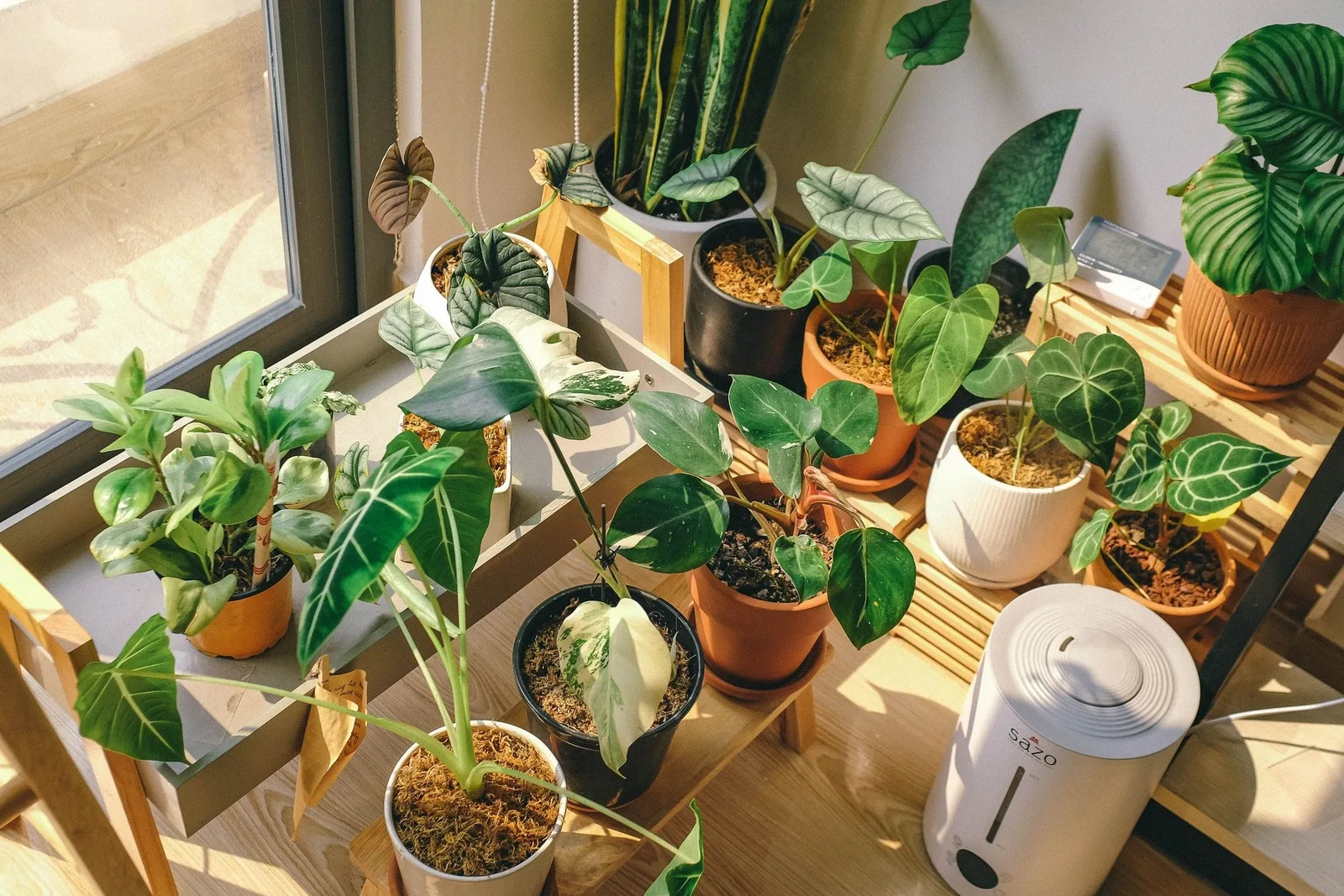
Heated homes are often dry in winter, while most tropical houseplants prefer roughly 50-70% humidity. That gap is why your Calathea has crispy edges, your fern is dropping fronds, and your Alocasia looks miserable from November through March. A humidifier for plants is not a luxury — for humidity-loving tropicals, it is often the most useful thing you can add after decent light.
Below we compare common humidifier types and several widely available models on the features that matter for plants: humidity control, tank capacity, noise, and ease of cleaning.
Cool Mist vs Warm Mist vs Ultrasonic vs Evaporative
| Type | How It Works | Pros | Cons | Best For |
|---|---|---|---|---|
| Ultrasonic Cool Mist | Vibrates water into micro-droplets | Quiet, energy efficient, affordable | Can leave white mineral dust on surfaces | Most plant setups, bedrooms |
| Warm Mist | Boils water into steam | Kills bacteria in water, no mineral dust | Uses more energy, hot surface risk, louder | Cold climates, allergy sufferers |
| Evaporative | Fan blows through wet wick filter | Self-regulating, no over-humidifying, no mineral dust | Louder fan noise, filters need replacing | Large rooms, whole-house humidity |
| Hybrid (Ultrasonic + Warm) | Switchable between modes | Flexibility | More expensive, more complex | People who want options |
Pro Tip
If you use an ultrasonic humidifier, use distilled or filtered water. Tap water contains minerals that the ultrasonic mechanism disperses as fine white dust that settles on everything. Distilled water eliminates this completely.
Humidity Levels by Plant Type
| Plant Category | Ideal Humidity | Minimum Tolerated | Examples |
|---|---|---|---|
| High Humidity Tropicals | 60-80% | 50% | Calathea, Alocasia, ferns, Anthurium |
| Medium Humidity Tropicals | 50-60% | 40% | Monstera, Philodendron, Peace Lily |
| Low Humidity Tolerant | 40-50% | 30% | Pothos, Snake Plant, ZZ Plant, Dracaena |
| Arid/Desert | 20-40% | 10% | Succulents, cacti |
The Pebble Tray Myth — Busted
You have probably read that placing a tray of pebbles and water under your plants raises humidity. Let us be direct: it barely does anything. A pebble tray adds only a little moisture, right next to the tray, and it disperses quickly in a ventilated room.
Pebble trays are great as drip trays and for catching runoff. They are not humidifiers. If your plants need humidity, get an actual humidifier.
1. Levoit LV600S — Best Overall
The LV600S pairs a large 6-liter tank with automatic humidity control. On low, the large tank means infrequent refills. The built-in humidistat lets you set a target humidity (say, 55%) and the unit adjusts output automatically. App control via the VeSync app adds smart home integration.
Why it is good: The combination of large tank, automatic humidity control, and quiet operation makes it a strong all-round option. Warm mist and cool mist modes give flexibility. The wide tank opening makes cleaning easy — a crucial feature, since mold in humidifier tanks is a real problem.
Pros:
- Large 6L tank — infrequent refills
- Built-in humidistat with auto mode
- Both warm and cool mist
- Quiet on low setting
- Wide opening for easy cleaning
- Smart app control
Cons:
- Large footprint — not small
- Warm mist mode uses significantly more energy
- App setup can be finicky
- White mineral dust if using tap water (use distilled)
2. Honeywell HCM-350 — Best Evaporative
The Honeywell HCM-350 is an evaporative humidifier, which means it does not produce mist at all — it pulls air through a wet wick filter. This has two major advantages: it cannot over-humidify (evaporation self-regulates based on ambient humidity) and it produces zero white mineral dust.
Why it is good: The self-regulating nature is the key benefit. In a room that is already fairly humid, an ultrasonic unit without a humidistat will keep pumping mist and can over-humidify. The HCM-350 will naturally slow down. This makes it ideal for rooms where you want consistent humidity without monitoring. The wicking filter also traps minerals and impurities.
Pros:
- Self-regulating — impossible to over-humidify
- No white mineral dust on surfaces
- Dishwasher-safe tank and tray
- UV treatment kills bacteria in water
Cons:
- Louder than ultrasonic units (fan noise)
- Replacement filters needed regularly (ongoing cost)
- Slower humidity output than ultrasonic
- Visible wick filter needs regular maintenance
3. Pure Enrichment MistAire — Best Budget
The MistAire is a compact ultrasonic cool mist humidifier with a 1.5L tank. It is simple: fill, turn on, aim the nozzle at your plants. The 360-degree nozzle directs mist where you want it. Runtime is about 16 hours on low. The night light is a nice touch for bedroom plant setups.
Pros:
- Affordable and widely available
- Compact — perfect for a nightstand or small shelf
- Very quiet
- 360-degree nozzle directs mist
Cons:
- Small tank — daily refills in dry conditions
- No humidistat — runs until empty
- Narrow tank opening makes cleaning harder
- Mineral dust with tap water
4. AIRCARE MA1201 Evaporative — Best for Large Rooms
If you have a large plant room, a sun room, or you want whole-house humidity, the AIRCARE MA1201 is a console-style evaporative humidifier that covers up to 3,600 square feet. A 3.6-gallon tank runs for 36 hours. The digital humidistat maintains your target automatically.
Pros:
- Covers very large spaces — up to 3,600 sq ft
- Huge 3.6-gallon tank
- Digital humidistat with auto mode
- Self-regulating evaporative technology
Cons:
- Large and heavy — not portable
- Fan can be audible on high settings
- Wicking filters need periodic replacement
- Console style — not aesthetically minimal
5. Canopy Humidifier — Best Premium
The Canopy takes a completely different approach. It uses evaporative technology with a dishwasher-safe internal system — no visible mist, no white dust, no soggy surfaces. The design is minimal and beautiful, looking more like a Scandinavian speaker than a humidifier. An embedded UV light kills bacteria before moisture is released.
Why it is good: No mist means no wet surfaces, no mineral dust, and no mess. The entire unit (minus the motor base) goes in the dishwasher. The smart sensor maintains target humidity. For people who want a humidifier that looks good and requires minimal effort, this is it.
Pros:
- Beautiful, minimal design
- No visible mist or mineral dust
- Dishwasher-safe components
- UV anti-bacterial treatment
- Quiet operation
Cons:
- Expensive
- Smaller coverage area than the Levoit or AIRCARE
- 2.5L tank needs refilling more often
- Replacement filters add ongoing cost
6. TaoTronics TT-AH046 — Best Compact Smart Option
A 4L ultrasonic humidifier with a built-in humidistat, top-fill design, and quiet operation. The top-fill is key — you lift the lid and pour water in without removing the tank. Small footprint fits on a shelf or table near your plants.
Pros:
- Top-fill design — easiest to refill
- Built-in humidistat
- 4L tank lasts 12-30 hours
- Compact footprint
Cons:
- Ultrasonic = mineral dust with tap water
- Not as powerful as the Levoit for large rooms
- No warm mist option
Room Size Calculator
| Room Size | Recommended Tank Size | Option From This List |
|---|---|---|
| Small (under 200 sq ft) | 1-2 liters | Pure Enrichment MistAire |
| Medium (200-400 sq ft) | 4-6 liters | Levoit LV600S or TaoTronics |
| Large (400-800 sq ft) | 6+ liters | Levoit LV600S |
| Very Large (800+ sq ft) | Console unit | AIRCARE MA1201 |
Placement Tips
- Place the humidifier near your plants, not across the room. Humidity disperses, but it is most effective within 3-6 feet of the source.
- Elevate it. Put the humidifier on a table or shelf, not the floor. Mist rises, so starting higher distributes more evenly.
- Keep it away from electronics and walls. Mist can condense on nearby surfaces, causing water damage or mold.
- Group humidity-loving plants together. They create a microclimate and benefit each other. Put the humidifier in the center of the group.
Warning
Clean your humidifier weekly. Stagnant water breeds bacteria and mold that get dispersed into the air you breathe. Empty, rinse, and wipe the tank with diluted white vinegar every 5-7 days. This is non-negotiable for health.
Buyer's Guide
- Tank size matters most. A larger tank means less frequent refilling. If you hate daily maintenance, get the biggest tank you can accommodate.
- Built-in humidistat saves hassle. Without one, the humidifier runs until empty regardless of humidity level. With one, it maintains your target automatically.
- Easy cleaning is crucial. If the tank has a narrow opening, you will not clean it, and mold will grow. Wide openings and dishwasher-safe parts win.
- Evaporative for set-and-forget, ultrasonic for power. Evaporative units self-regulate but are louder. Ultrasonic units are quiet and powerful but need monitoring.
Frequently Asked Questions
Do I really need a humidifier for my plants?
If you grow only pothos, snake plants, and ZZ plants — probably not. They tolerate 30-40% humidity fine. If you grow calatheas, ferns, alocasias, or any tropical that shows crispy leaf edges in winter, yes — a humidifier will transform their health.
Can too much humidity be a problem?
Above 70% indoors, you risk mold growth on walls, furniture, and soil. Keep humidity between 50-65% for the best balance of plant health and home health. A hygrometer helps you monitor.
Does misting replace a humidifier?
No. Misting raises humidity for about 15 minutes before evaporating. A humidifier maintains consistent humidity for hours. Misting is essentially useless for sustained humidity — it is a ritual, not a solution. It can also promote fungal issues on leaves that stay wet.
What about grouping plants together?
Grouping plants creates a modest microclimate as they transpire moisture. It helps, but the effect is small. Combine grouping with a humidifier for the best results.
How do I measure humidity?
Get a digital hygrometer. Inexpensive digital models, such as the ThermoPro TP50, also show temperature. Place it at plant level, not across the room.