Quick Summary
Snake plants can be propagated three ways: division (instant results, preserves variegation), leaf cuttings in water (3-6 weeks to root), or leaf cuttings in soil (4-8 weeks to root). Division is best for variegated varieties. Leaf cuttings are slow but satisfying. All methods work best in spring and summer.
Snake plants (Sansevieria, now reclassified as Dracaena trifasciata) are among the hardiest houseplants you can own, and learning how to propagate snake plant is surprisingly straightforward. Whether you want to multiply your collection, share plants with friends, or rescue a damaged leaf, there are three reliable methods and this guide covers all of them in detail.
What You Will Need
Before you start, gather these supplies:
- A clean, sharp knife or pruning shears (sterilize with rubbing alcohol)
- Small pots (4-inch terracotta pots work great for drainage)
- Well-draining soil mix (50/50 perlite and cactus/succulent mix)
- A clear glass jar or vase (for water propagation)
- Room-temperature filtered water
- A marker or small piece of tape (to mark cutting orientation)
- Optional: rooting hormone powder (speeds up root development by 1-2 weeks)
Best Time to Propagate
Snake plants can technically be propagated year-round, but spring and early summer give you the best results. During the active growing season (April through September), root development is faster and success rates are higher. Avoid propagating in winter when the plant is dormant — cuttings root much slower and are more prone to rot in cool, low-light conditions.
Method 1: Division (Fastest Results)
Division is the quickest way because you are separating an already-rooted section. This works best when your plant has multiple leaf clusters and is the only method that preserves variegation.
- Remove the plant from its pot. Lay it on its side and gently slide it out. If the plant is rootbound, run a knife around the inside edge of the pot to loosen it. Water the plant a day before dividing to make the root ball more pliable.
- Shake off excess soil. Gently remove soil from the roots so you can see the rhizome structure clearly. You can rinse the roots under lukewarm water if needed.
- Identify natural divisions. Look for separate clumps with their own root systems connected by underground rhizomes. Each viable division should have its own set of roots and at least 2-3 healthy leaves.
- Separate the clumps. Use a clean, sharp knife to cut through the rhizome. Make decisive cuts rather than sawing back and forth, which damages tissue. Each division should have at least 2-3 leaves and healthy roots.
- Let cuts dry. Allow cut surfaces to callus for 24 hours in a dry, shaded spot. This step is critical — planting fresh cuts directly into moist soil invites rot.
- Pot each division in well-draining cactus/succulent mix. Choose a pot only slightly larger than the root ball. Water lightly and place in bright, indirect light.
Expected timeline: Divisions are essentially established plants. They may take 1-2 weeks to recover from the shock of being separated, but will resume normal growth quickly. You should see new leaf spikes within 4-8 weeks during the growing season.
Pro Tip
Division is the only propagation method that preserves variegation in varieties like Sansevieria "Laurentii" and "Futura Superba." Leaf cuttings from variegated snake plants almost always revert to solid green because the yellow or white edges are chimeral — they exist only in the outer cell layers and are not carried through to new growth from leaf tissue.
Method 2: Leaf Cuttings in Water
Water propagation is the most visual method — you can watch roots develop through the glass, which makes it especially satisfying for beginners.
- Select a healthy leaf from the outer ring of the plant. Choose one that is firm, plump, and free of damage. Avoid yellowing or soft leaves. Cut it at the base with a clean blade.
- Cut the leaf into 3-4 inch sections. Mark which end is the bottom (closer to soil) with a small notch or tape. This is crucial — cuttings planted upside down will not root. Some people cut a small V-notch in the bottom to increase the surface area for root development.
- Let the cuts callus for 1-2 days in a dry, shaded area. The cut surfaces should feel dry and slightly hardened to the touch before proceeding.
- Place the bottom end in water, about an inch deep. Use a clear glass so you can monitor progress. Filtered or dechlorinated water is best — heavily chlorinated tap water can inhibit root growth.
- Change water every 5-7 days and keep in bright, indirect light. Fresh water provides oxygen and prevents bacterial buildup. If the water looks cloudy before the weekly change, swap it out immediately.
- Wait patiently. Roots appear in 3-6 weeks. You will see small white or pale yellow nubs emerging from the bottom of the cutting first. Over the next few weeks, these develop into proper roots. New pup shoots (tiny baby snake plants) may take 2-3 months to appear at the base of the cutting.
Week-by-Week Water Propagation Timeline
| Week | What to Expect |
|---|---|
| Week 1-2 | Callus fully hardens. No visible changes. The cutting may slightly curl — this is normal. |
| Week 3-4 | Tiny white root nubs appear at the submerged end. Some cuttings may show small orange or white bumps first. |
| Week 5-6 | Roots lengthen to 1-2 inches. You may see multiple root strands branching out. |
| Week 7-8 | Roots reach 2-3 inches. The cutting looks stable and healthy in the water. |
| Week 8-12 | A small pup (baby plant) begins to emerge from the base of the cutting. This is the new plant growing. |
| Month 3-4 | Pup has 1-2 small leaves. Ready to transfer to soil once roots are well-established. |
Method 3: Leaf Cuttings in Soil
Soil propagation is the most hands-off method once set up. The cuttings root directly into their growing medium, which means no transplant shock later.
- Prepare cuttings the same way as for water: 3-4 inch sections, bottom marked, callused for 1-2 days. Optional: dip the bottom end in rooting hormone powder before planting.
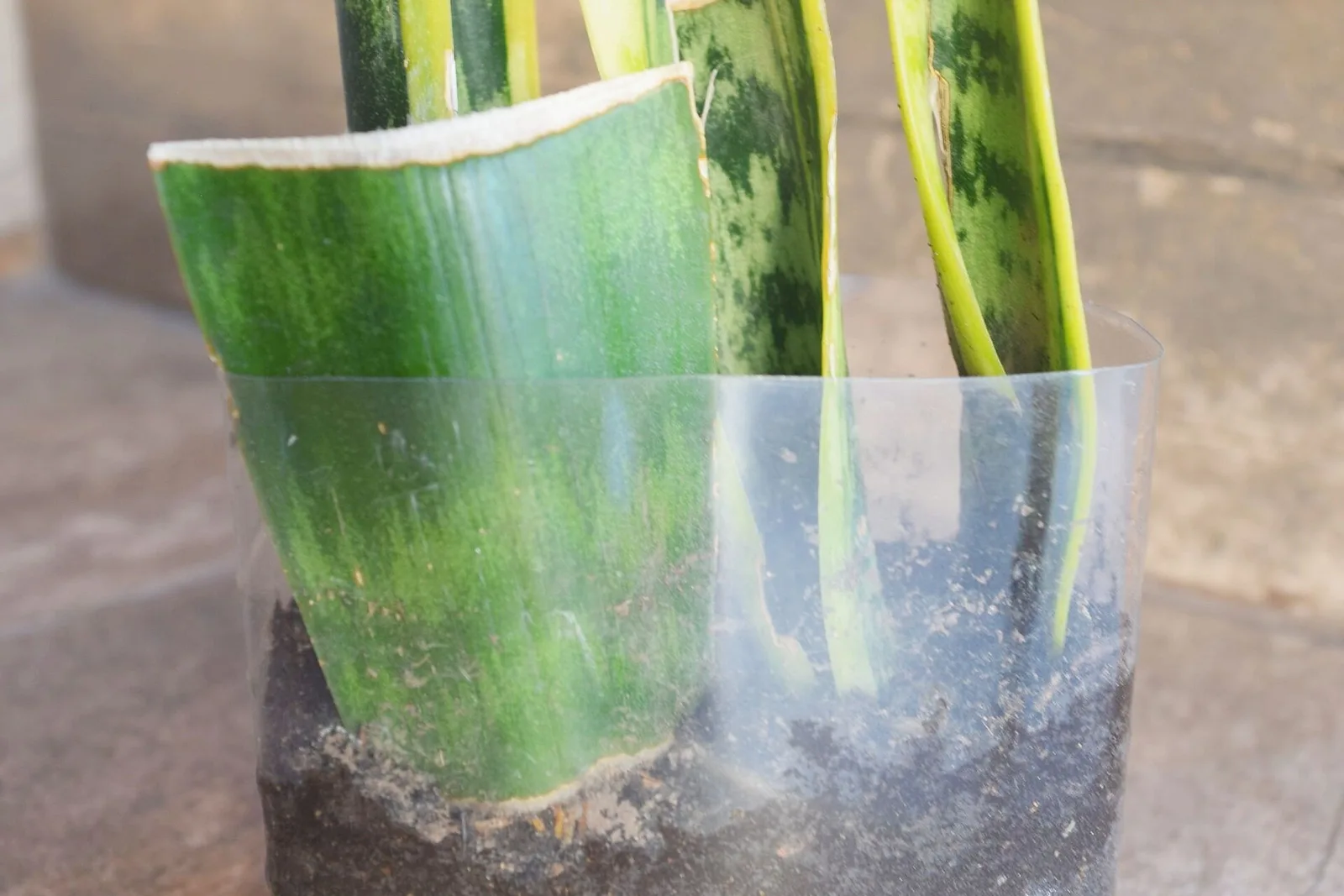
- Fill a pot with 50/50 perlite and succulent soil. This mix provides excellent drainage while retaining just enough moisture for root development. A small terracotta pot (4-6 inch) is ideal because it breathes and dries evenly.
- Insert the bottom end about an inch into the soil. You can place multiple cuttings in one pot, spacing them about 2 inches apart. Press the soil gently around each cutting so it stands upright.
- Water sparingly. Let soil dry almost completely between waterings. Snake plant cuttings rot easily — overwatering is one of the most common reasons soil propagation fails. Water every 10-14 days at most.
- Provide warmth and light. Place in bright, indirect light with temperatures between 65-85°F. A warm spot speeds up root development significantly.
- Be patient. Roots take 4-8 weeks. New pups may take 2-4 months. You will know roots have developed when you give the cutting a very gentle tug and feel resistance.
Pro Tip
Place your propagation pot on a heat mat set to 70-75°F. Warmth at the root zone can noticeably speed up rooting.
The Best Soil Mix for Snake Plant Propagation
The propagation mix needs to be fast-draining to prevent rot while holding just enough moisture for roots to develop. Here are three common mixes:
- Simple mix: 50% perlite + 50% cactus/succulent soil
- Premium mix: 40% perlite + 30% cactus soil + 30% coarse sand
- Ultra-draining mix: 60% perlite + 20% pumice + 20% succulent soil (best for humid climates where rot risk is higher)
Avoid regular potting soil on its own — it retains too much moisture and compacts around cuttings, suffocating developing roots.
Temperature Requirements
Temperature plays a bigger role in propagation success than most people realize:
- Ideal range: 70-85°F (21-29°C) — this is where root development is fastest
- Acceptable range: 65-90°F (18-32°C) — growth slows but still happens
- Danger zone: Below 60°F (15°C) — root development stalls and rot risk skyrockets
- Night temperatures should not drop below 65°F for best results
If your home runs cool, especially in winter, a seedling heat mat under your propagation pot makes a significant difference. They are inexpensive and available at most garden centers.
Which Method Should You Choose?
| Method | Speed | Difficulty | Keeps Variegation? | Best For |
|---|---|---|---|---|
| Division | Instant | Easy | Yes | Mature, crowded plants with multiple clumps |
| Water cuttings | 3-6 weeks to root | Easy | No | Beginners who want to watch the process |
| Soil cuttings | 4-8 weeks to root | Easy | No | Hands-off approach, multiple cuttings at once |
The Variegation Warning (Explained)
This is one of the most common disappointments in snake plant propagation, so it is worth explaining in detail. If you propagate a variegated snake plant like Sansevieria "Laurentii" (yellow edges) or "Bantel's Sensation" (white stripes) using leaf cuttings, the new baby plants will almost certainly grow in as solid green.
Why? The variegation in most snake plant varieties is chimeral, meaning the colored cells only exist in specific tissue layers of the leaf. When a new plant grows from a leaf cutting, it regenerates from the inner cell layers — which are solid green. The outer decorative layers do not carry over.
If preserving variegation is important to you, division is the only reliable method. Each divided section retains the original cellular structure, including the variegated tissue layers.
Troubleshooting Failed Propagations
Cuttings Are Mushy or Rotting
That is rot, usually from too much water or not enough callus time. Remove the mushy part immediately — cut at least half an inch above the rot into healthy tissue. Let the fresh cut callus for 2-3 days, then try again with less water. For water propagation, use only an inch of water. For soil, wait longer between waterings.
No Roots After 6+ Weeks
Check these factors: Is the cutting right-side up? (Bottom end should be in water/soil.) Is the temperature warm enough? (Below 65°F, rooting stalls.) Is the light bright enough? (Too dim = too slow.) Try dipping the bottom in rooting hormone and placing it in a warmer spot.
New Growth Is Solid Green
Leaf cuttings almost always revert to green. For variegated varieties, use division instead. There is no way to force variegation in cuttings from leaf tissue — it is a genetic limitation.
Cuttings Are Wrinkling or Shrinking
Some shrinkage is normal as the mother cutting feeds nutrients to the developing roots and pup. However, if the cutting becomes paper-thin or very wrinkled, it may not be getting enough light. Move it to a brighter spot. In water, ensure the water level stays consistent.
Mold on Soil or Cutting
White fuzzy mold appears when there is too much moisture and not enough airflow. Remove any visible mold, let the soil dry out completely, and improve air circulation around the pot. A small fan on low speed pointed nearby helps.
Pro Tip
Keep a propagation journal or take weekly photos. Snake plant propagation is slow, and it is easy to get discouraged when you cannot see progress. Looking back at photos from three weeks ago reminds you that things are actually moving along.
Frequently Asked Questions
Can I propagate a damaged or broken snake plant leaf?
Absolutely. If a leaf breaks or gets damaged, you can turn it into cuttings. Let the broken end callus for 1-2 days, then propagate using the water or soil method. As long as the leaf tissue is firm and healthy (not mushy or yellowed), it can root successfully.
How many new plants can I get from one leaf?
A single full-sized snake plant leaf (12-24 inches) can be cut into 3-6 sections, and each section can produce one new plant. That means one leaf can potentially give you half a dozen new snake plants, though expect some sections to fail. As a rough guide, expect most sections to root (often around 70-80%).
Should I use rooting hormone?
It is not required — snake plants root readily without it. However, rooting hormone can speed up the process by 1-2 weeks and may improve success rates slightly, especially in cooler conditions. If you have it, use it. If you do not, do not worry about buying it just for snake plant propagation.
When should I transfer water-propagated cuttings to soil?
Wait until roots are at least 2-3 inches long and you see the beginning of a pup (baby plant). Transfer sooner if you prefer, but longer roots mean an easier transition. When you do transfer, keep the soil consistently moist (not wet) for the first 2 weeks to help the water-adapted roots adjust to soil.
Sources and further reading
- How to Propagate Houseplants by Leaf Section Cuttings — Iowa State University Extension and Outreach
- How to Propagate Houseplants by Division and Offsets — Iowa State University Extension and Outreach
- Leaf cuttings — Royal Horticultural Society