Sticky Leaves on Houseplants: Causes and Solutions
Quick Summary
- Sticky leaves are almost always caused by honeydew — a sugary waste product excreted by sap-feeding insects
- The five main culprits: scale, mealybugs, aphids, spider mites, and whitefly
- Black sooty mold often follows honeydew — it grows on the sugary residue
- Isopropyl alcohol and insecticidal soap are the most effective treatments
- Check undersides of leaves and stem joints — that is where pests hide
If your plant leaves feel sticky or you notice a shiny, tacky film on the surface, this is not the plant producing moisture — it is a warning sign. Sticky leaves on houseplants are almost exclusively caused by honeydew, the sugary liquid waste excreted by sap-feeding insects. The stickiness is an indirect symptom; find the pest causing it and you solve the problem at the source. Left untreated, honeydew attracts secondary fungal infections (sooty mold) and the pest population will continue multiplying until it causes serious damage.
What Causes Sticky Leaves
Scale Insects
Scale are among the hardest pests to identify because they do not look like insects — they look like small brown, tan, or white bumps attached to stems and the undersides of leaves. They are covered by a hard shell (armored scale) or a softer waxy coating (soft scale) that protects them from contact treatments. Soft scale species produce the most honeydew of any common houseplant pest — a heavy infestation can coat leaves and the surface below the plant. Scale feeds by inserting a stylet into the plant vascular tissue and draining sap. They are nearly immobile once settled, but young crawlers are tiny and spread easily to neighboring plants.
Mealybugs
Mealybugs are soft-bodied insects covered in white waxy filaments that make them look like tiny cotton tufts. They cluster in leaf axils, along stems, and on root systems. While most people recognize the white cottony visual, they also produce significant honeydew. A mealybug infestation will result in sticky leaves, a shiny residue on surfaces below the plant, and often the telltale white fluff at stem joints. They reproduce rapidly in warm, dry indoor conditions and can go from a few bugs to a full infestation in weeks.
Aphids
Aphids are small, soft-bodied insects — green, black, yellow, or brown — that cluster on new growth, flower buds, and the undersides of leaves. They feed in large groups and produce substantial quantities of honeydew. An aphid infestation often causes distorted, curled, or puckered new growth in addition to sticky leaves. They reproduce asexually and extremely rapidly — a single aphid can produce dozens of offspring in a week. Outdoors they are controlled by predators like ladybugs; indoors they can multiply unchecked.
Spider Mites
Spider mites are technically arachnids, not insects, and they are extremely small — barely visible to the naked eye. They cause stippled, pale, or bronzed leaves with fine webbing between leaves and stems. While they do not produce honeydew in the traditional sense, they can cause a slightly tacky feeling on leaves from their feeding activity and the dust-like debris they leave. If you see fine webbing combined with sticky residue, you likely have spider mites alongside another pest, or early-stage mites with another residue source.
Whitefly
Whiteflies are small, white-winged insects that fly up in a cloud when you disturb an infested plant. Adults, nymphs, and eggs all feed on leaf undersides and produce honeydew. Unlike scale or mealybugs, you will usually see them when you move the plant. Whitefly infestations also cause yellowing and wilting of leaves as the population grows. They are particularly common on plants brought in from outdoor environments and on edibles like tomatoes and herbs kept on kitchen windowsills.
How to Identify the Pest
| Pest | What You See on Plant | Sticky Residue Level | Other Symptoms |
|---|---|---|---|
| Scale | Brown or tan bumps on stems/undersides | Heavy | Yellowing leaves, sooty mold |
| Mealybugs | White cottony clusters at joints | Moderate to heavy | Wilting, white residue |
| Aphids | Clusters of tiny soft bugs on new growth | Heavy | Curled, distorted new leaves |
| Spider mites | Fine webbing, tiny dots moving | Light | Stippled, bronzed leaves |
| Whitefly | White cloud when plant is disturbed | Moderate | Yellowing, flying insects |
Pro Tip
Check the underside of 5-6 leaves, the stem joints (where leaves meet the stem), and the soil surface. This is where all five of these pests prefer to hide. Use a magnifying glass — spider mites and young scale crawlers are nearly invisible to the naked eye. If you see black sooty mold on top of the honeydew residue, the infestation has been present for some time.
Treatment Steps
Regardless of the pest, follow this sequence:
- Isolate the plant immediately. Move it away from all other plants. Pests spread on air currents (aphids, whitefly), through physical contact, and via crawlers (scale, mealybugs).
- Remove heavily infested parts. Trim leaves or stems with dense pest populations. Dispose in sealed plastic bags in the trash — not compost.
- Treat with your chosen method and coat the entire plant — both leaf surfaces, all stems, and the soil surface.
- Repeat every 5-7 days for 3-4 weeks. A single treatment kills active adults but not eggs. Consistent retreatment catches newly hatched generations.
- Monitor weekly even after the apparent infestation clears — reinfestations from missed eggs are common.
DIY Treatments
Neem Oil Spray
Neem oil is a broad-spectrum insecticide and fungicide derived from the neem tree. Mix 2 teaspoons cold-pressed neem oil with 1 teaspoon dish soap and 1 liter of warm water. Shake well and spray every surface of the plant until dripping. Neem works by disrupting insect hormone cycles and suffocating eggs. It is highly effective against aphids, mealybugs, and whitefly. Apply in the evening — neem oil can cause mild leaf burn on plants in bright direct sun.
Insecticidal Soap Spray
Insecticidal soap kills pests on contact by breaking down their protective coatings. You can buy commercial formulations or make a basic version: 1-2 teaspoons of pure castile soap (not detergent) in 1 liter of water. Spray directly onto pests — it must contact them to work. Effective on aphids, mealybugs, and whitefly. Less effective on scale (the shell protects them). Safe for most plants but test on one leaf first for sensitive species.
Rubbing Alcohol (Isopropyl)
70% isopropyl rubbing alcohol dissolves the waxy protective coating of scale and mealybugs on contact. Use a cotton swab dipped in alcohol and touch each pest directly. For larger areas, dilute to 1 part alcohol in 3 parts water and spray or wipe all plant surfaces. This is one of the fastest and most satisfying treatments for scale — watch them dissolve in real time. Let the plant dry completely before returning it to its spot.
Cleaning Sticky Residue
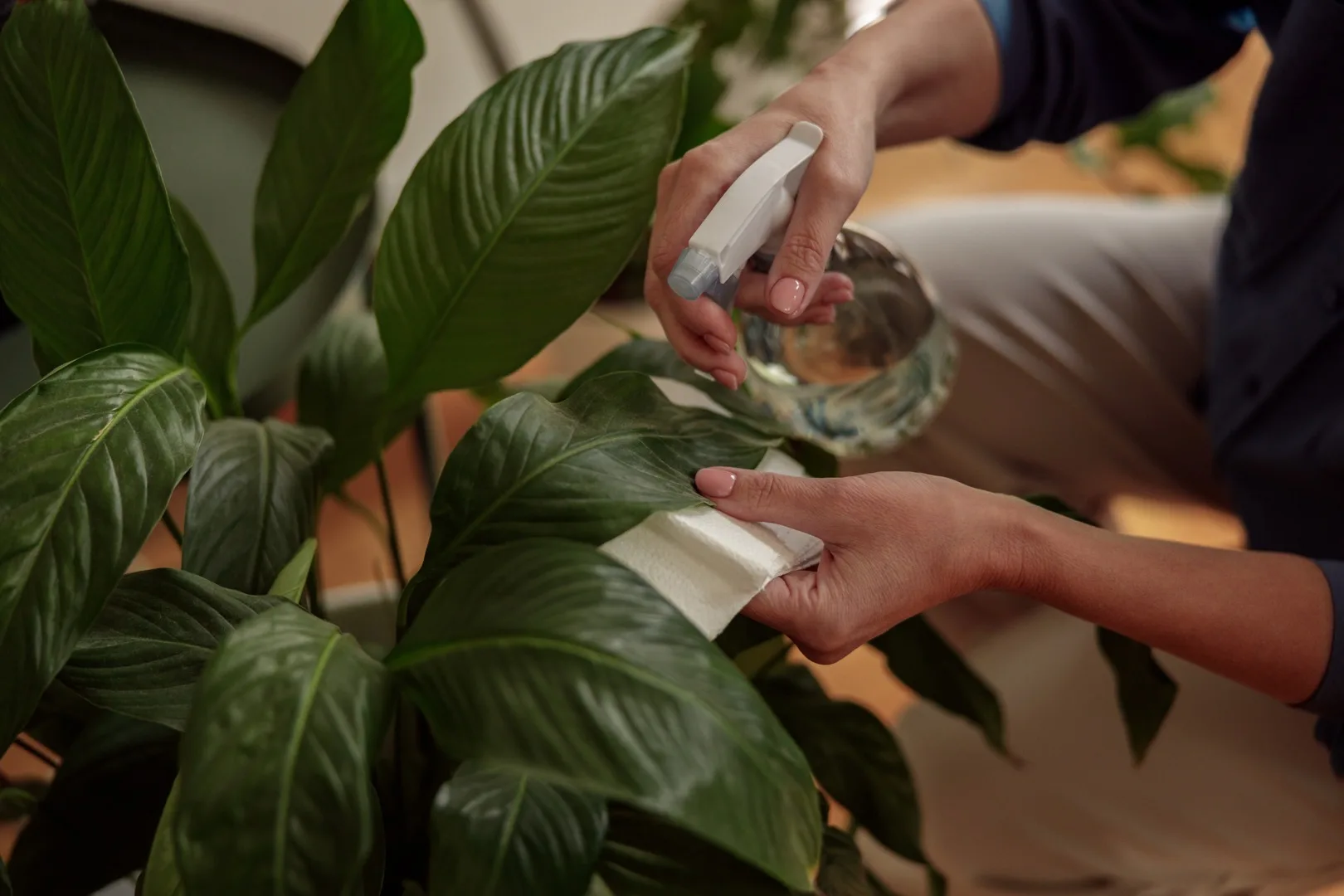
After treating the pests, you will need to clean the honeydew residue from leaves. Use a soft cloth dampened in warm water with a tiny drop of dish soap — gently wipe each leaf on both surfaces. For black sooty mold (which grows on top of honeydew), a diluted baking soda solution (1 teaspoon per liter of water) helps break it down. Clean the surface around and below the plant as well — honeydew drips can attract ants, which actually farm and protect pests like aphids and mealybugs.
Prevention
The single most effective prevention measure is a 2-3 week quarantine for all new plants before they go near your existing collection. Inspect every new plant thoroughly before purchase — check undersides of leaves and stem joints. Keep your plants healthy: a stressed plant is more susceptible to infestation. Regularly wipe leaves to remove dust — a light coat of neem oil on a cloth used to clean leaves leaves a protective residue that deters pests. Check plants monthly even when they appear healthy.
Frequently Asked Questions
Is the sticky residue harmful to the plant? The honeydew itself does not directly harm the plant, but the pests producing it do — through sap extraction, leaf distortion, and by attracting sooty mold that blocks photosynthesis. Treat the pest, not just the residue.
Why do I keep getting scale on the same plant? Scale eggs are protected under the parent shell and are resistant to contact treatments. You may be killing adults but missing eggs. Consistent treatment every 5-7 days for a full month, combined with repotting in fresh soil (scale can hide in soil too), usually resolves persistent infestations.
Can sticky residue attract other pests? Yes. Ants are attracted to honeydew and will actively protect pest colonies from predators. If you see ants on or around your plants, look for the pest producing the honeydew they are harvesting.
Written by
Plant Care Club
The Plant Care Club team combines years of hands-on plant parenting with science-based research to create guides you can actually trust. We test, we grow, we learn — so you can too.
94 articles published
Was this helpful?
Thanks for your feedback!
Related Articles
 Air Purifying
15 Best Air Purifying Plants for Your Home (Science-Backed)
Discover the 15 best air purifying plants backed by science — with care difficulty, pet safety ratings, and which room each one works best in.
 Air Purifying
Does Snake Plant Really Purify Air? Facts vs Fiction
Does the snake plant really purify air? We break down the NASA study, what toxins snake plants actually filter, and how many you need for a real effect.
 Plant Styling
Best Indoor Herb Garden Kits for 2026 (Tested & Ranked)
AeroGarden, Click & Grow, Gardyn, and five more indoor herb garden kits reviewed and ranked for 2026. Find the best kit for your kitchen and budget.